


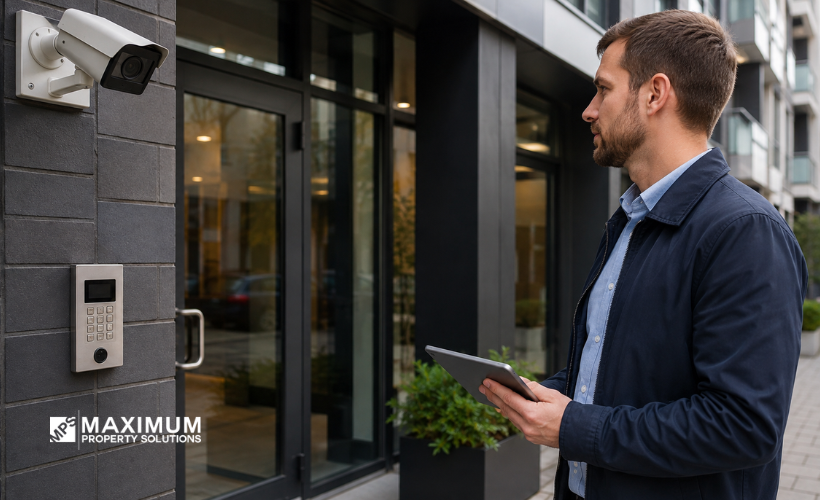
Security for Property Managers comes down to five recurring security threats: unauthorized building access, theft of packages and vehicles, vandalism and property damage, negligent security liability, and security breaches involving tenant data. These safety concerns overlap. A security strategy that treats them as one connected risk beats five separate fixes.
At Maximum Property Solutions, that overlap is what we look for during a property inspection. One propped service door is a vulnerability, a privacy problem, and an insurance problem at once. This holds across single family rentals, residential buildings, and lender held properties, where property owners and property management teams carry the same duty.
Which Security Challenges for Property Managers Surface Most Often?
Four issues account for most criminal activity at Ontario rental properties: unauthorized entry, package and vehicle theft, vandalism, and unsecured tenant records. Almost every case starts as a small operational gap, so crime prevention begins with observation, not hardware.
Incidents rarely start with a career criminal. They start with a door that closes too slowly, a fob nobody collected at move out, or a vacant unit nobody has walked in weeks. Good security is the habit of catching these early and choosing to prioritize the repair.
Unauthorized Access and Entry Point Failures
Most unauthorized entry in Ontario buildings happens through propped doors, not forced ones. Tailgating, unreturned keys, and wedged service entrances defeat access control without a single break-in. Intruders then move through hallways, lockers, and mechanical rooms looking like they belong.
Every building has more entry points than its floor plan suggests: lobbies, parking ramps, garbage rooms, and roof hatches. Managing access across all of them is your first line of defence, because once someone is inside, they look like a guest.
Four failure points recur:
- Tailgating: someone follows a resident through a secured door.
- Key and fob drift: copies accumulate until nobody knows how many exist.
- Vacant units: empty space invites squatting, copper theft, and water damage.
- Perimeter neglect: dead lighting and broken closers signal nobody is watching.
Theft, Vandalism, and Parking Area Risk
Package theft, vehicle break ins, and graffiti cluster in the same low visibility spots: un-monitored lobbies, poorly lit parking lots, and rear entrances. These are crimes of opportunity. Adequate lighting and clear sight lines deter them better than any piece of security technology.
Parcel volume has turned many lobbies into unattended storage. With vandalism, the repair bill is rarely the real cost. Graffiti and broken fixtures tell everyone nobody is paying attention, and a well-lit, maintained property is a stronger deterrent than a camera nobody watches.

Where Does Ontario Law Place the Liability?
The Occupiers’ Liability Act, R.S.O. 1990, c. O.2, requires anyone controlling a property to take reasonable care to ensure the safety of people entering it. Property managers count as occupiers. That makes security a legal obligation, not an optional upgrade.
Section 3(1) creates a positive duty, and courts judge it on foreseeability. A broken lobby lock reported twice and never fixed is very different from a first time incident. Where a documented complaint was ignored, the occupier could be held liable.
Ontario’s Residential Tenancies Act adds a second layer:
| Ontario rule | What it governs | Practical effect |
|---|---|---|
| Occupiers’ Liability Act, s. 3(1) | Reasonable care for persons on the premises | Documented inspections are your defence |
| Residential Tenancies Act, ss. 25 to 27 | Entry into a rental unit | 24 hours written notice, 8 a.m. to 8 p.m. |
| RTA s. 26 | Emergency entry and consent | No notice required in a genuine emergency |
Common areas sit outside the unit entry rules. So hallway lighting and access control systems on shared doors are the fastest lawful improvements for any property management company in Ontario.
How Do Digital Risks Reach Property Managers?
Ontario landlords and property managers are bound by PIPEDA, Canada’s federal privacy law, because Ontario has no equivalent provincial statute. Tenant records held in property management software count as regulated personal information, and a breach carries reporting obligations.
Physical and digital security merged when buildings adopted surveillance cameras, smart locks, and Wi-Fi entry systems. A device left on its factory password opens the network holding tenant records. Listing fraud adds another angle: criminals copy real listings and collect deposits from applicants.
Four security protocols cover most of this exposure:
- Change every default password on cameras, locks, and intercoms at installation.
- Restrict tenant file access to staff who need it.
- Use written consent language stating why data is collected.
- Monitor listing sites for cloned ads using your photos and address.
What the Windsor Crime Numbers Actually Say About Your Risk
Windsor and Amherstburg recorded a 10.41 percent drop in overall crime severity in the latest Statistics Canada release, with non-violent severity down 14 percent. Falling regional crime does not reduce your duty, because liability is judged at your specific address.
Nationally the Crime Severity Index fell roughly 5 percent, with break and enters down about 11 percent since 2015. Shoplifting, however, rose for a fifth straight year. Property crime is changing shape, not going away.
Averages describe a region. A negligence claim examines one building on one date. That is why Maximum Property Solutions documents findings in writing, and why a proactive approach to property security costs far less than a defence.
Building a Comprehensive Security Program That Holds Up
A defensible program has five parts: a documented walkthrough, a controlled key inventory, hardened common areas, scheduled inspections, and written security policies. Writing things down turns good intentions into evidence of reasonable care, and makes tenant safety something you can measure.
Start with a perimeter walkthrough at dusk, since lighting gaps only show up after dark. Then be honest about your security needs. Most residential properties never require security guards or a standing security presence. A troubled site may justify on-site security through licensed security professionals. Security experts will sell robust security hardware, but the most effective strategies are cheaper: better locks, lighting, and records.
If a property warrants professional security, agree on escalation before you need it. A security team or contracted security personnel should know which unusual activity to log, which to escalate, and who takes the call. Modern security systems push real-time alerts, but an alert nobody answers protects nobody.
From there, the sequence that keeps a property secure is simple:
- Audit every entry point, including service doors and roof access.
- Replace failing door closers and dead exterior lighting first.
- Set a written inspection schedule and keep dated records.
- Verify occupancy on vacant and lender held units on a set cycle.
- Log every tenant report of safety risks with date and outcome.
Frequently Asked Questions
Do landlords in Ontario need to give notice before entering a rental unit for a security repair?
Yes. Under the Residential Tenancies Act, a landlord must give at least 24 hours written notice stating the reason and a time between 8 a.m. and 8 p.m. Entry without notice is allowed only in a genuine emergency or with consent.
Can a property manager install security cameras in a rental building?
Cameras are generally permitted in common areas such as lobbies, hallways, and parking areas, but not in rental units or anywhere tenants reasonably expect privacy. Signage, a stated purpose, and secure storage of recordings are expected under privacy law.
Who is responsible when a tenant’s property is stolen from a common area?
Responsibility depends on whether reasonable measures were in place. If a known defect such as a broken lock contributed to the theft, the occupier may face liability. Tenant insurance covers the tenant’s belongings.
How often should rental properties be inspected for security issues?
Quarterly inspections suit most occupied properties. Vacant and lender held properties warrant monthly checks. Any report of a broken lock, door, or light should trigger an immediate response.
Protecting Your Tenants and Your Investment
Effective Security for Property Managers is not a single purchase. It is the habit of walking the property, fixing the gaps you find, and writing down what you did. Ensuring the safety and security of your residents protects personal safety, preserves asset value, and builds trust that shows up at renewal.

If a secure environment is a top priority for your Windsor and Essex County rental portfolio, Maximum Property Solutions is ready to walk the property with you and build a plan around what we find.
